Project Paradis: Entry 002

When we were little kids (and now as big kids) we imagined parkouring around and traversing this complex landscape with ease. Vaulting through the railings, scrambling up the stone retainers, leaping from one wall to the roof of the chicken coop with athletic precision and grace. Dragon Ball, Pokémon, The Lion King and more all informing these incredible fantasies and adventures. Now it also sounds like it would be a perfect element nestled somewhere in an Assassin's Creed level or Cyan game. Two vastly different play styles and I have a feeling Paradis can work for both. Let's put that idea to the test.
The Level
Recreating this real place as a functional level design is going to be an interesting challenge. The garden was designed mostly for function; making it possible for someone to access all areas without too much trouble. The traditional landscaping techniques used provide us with a wealth of areas that could work perfectly for our needs: pathing and points of interest.

The garden is carved into a hillside into level areas for the crops to grow and walkways to tread. Creating planar surfaces in a hillside or mountain like this is a method humans have been using pretty much since humans have been farming (that’s a long time… you do the math.)
The foundation of our layout will be terraces. Functional, dynamic, interesting, visual levels with opportunities for stacking the scenic elements at focus points - so much to work with already!
The Terraces (Terrain Foundation)
Terraced farming is a method to grow crops reliably on sloping hills of varying degrees. In this particular region of northern Italy, the alps are beginning to take shape. Traveling north toward this location will show the rapid change in landscape from the expansive plains to curving mountain roads that seem to gain significant elevation with each passing moment. Is there an end or will these mountains lift you up into the sky?
Below is a picture taken in the woods nearby; an example of the land having been cultivated for agriculture by our ancestors and then left to regrow and (still now) to be reused. It's always a treat to find these winding walls as you explore the woods. Every so often the walls will have small steps inset into them; a shortcut for the farmers while they tended to their crops and livestock.

Paper Maps and Spatial Allocation
While the garden is fun to run around and climb in reality, that doesn’t necessarily translate to being fun or interesting in a game. I want to explore spatial allocation- for our purposes this will be areas where the player may spend more time or find elements that propel them forward in the narrative/ gameplay.
Here’s a quick sketch of our garden layout as it is:

As mentioned before, there’s a lot of interesting terrain to play around with. For now, our high level goal for the player will be getting from point A to B. The reasons why and particular points of interest will vary depending on the gameplay style.
The garden has several areas with stone stairs for efficient access. To make things more interesting for the player, I want to close off some of those pathways in ways that support the level narrative. Whether that is broken environment elements, barricades or a felled tree (perhaps even a conveniently placed Snorlax.)
Below is a quick spatial allocation map to explore those areas that, depending on the possibility of their gameplay/ narrative significance, can be constructed to highlight that importance within the game space. This exercise also helps keep me from staying within the strict boundaries of realism. I happen to know this location like the back of my hand, but that can sometimes be restrictive when recreating real places in gameplay environments!

This kind of mapping exercise can generate new traversal/ puzzle/ goal reaching strategies that aren’t bound by looking at the fixed architecture as it is. The possible existing pathways are marked in green, while areas where some shortcuts could be created are in red. I’m also thinking about how the camera will see these perspectives and where we might have opportunities for significant visual moments that could help tell the story and subtly guide the player.
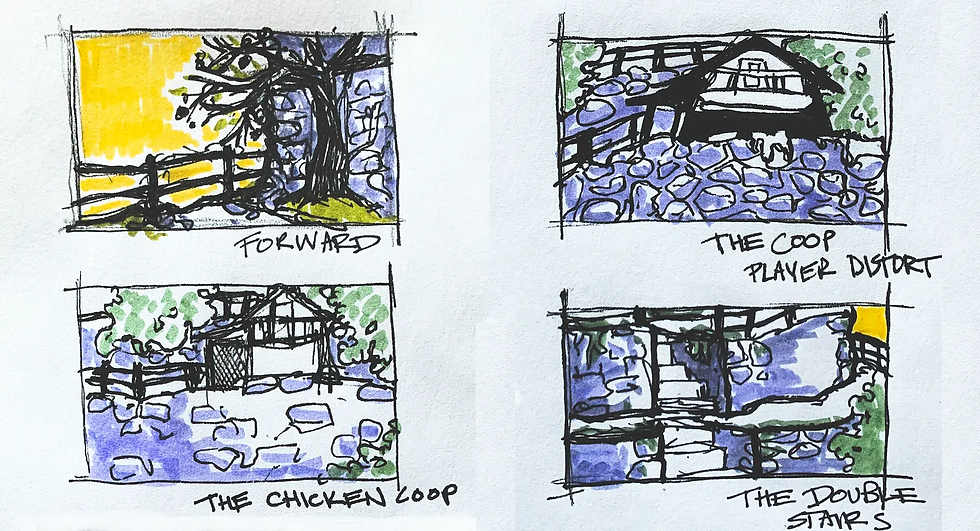
Next, greyboxing. A greybox of a level is a model of the level with the minimum amount of structural information needed to understand if the design is working. We’ll take a look at adjusting a large majority of any traversal, scale, sightlines, POIs issues and more at this stage. Iterate often and early.


Comments