The Ginkgo Tree

History and Symbolism
The courtyard in a Hanok is where family and community gather. We wanted to create a central spot where the player can enjoy the peaceful calm of sitting under the tree and a point of reference as the centerpiece of our home. While the architecture of the house has made use of as many open windows as possible, this courtyard affords us another opportunity to give the player a place to “breathe”. Enclosures can be restrictive in 3D environments, particularly VR. An open floor plan keeps the player’s view free from close-up obstructions; avoiding elements that can cause discomfort.
This type of tree is known for its resilience and longevity and for those reasons, among others, became a respected symbol in many parts of Korean culture and around the world. It has a fascinating history as a plant that has barely changed over the last 200 million years- a living fossil in our time. For more on the fascinating biology of the Ginkgo, check out this article interviewing botanist Peter Crane:
The fan-shaped leaves themselves are seen in art and symbolism, interpreted often as an indicator of duality, balance of opposites, and harmony in life. Parts of the tree are also used in traditional medicine; namely the leaves and nuts. The flesh of the fruit is well known for its particular… perfume… but players don't have to worry about that with this virtual version!
For KORE, the Ginkgo symbolizes a balance between history and the future, our connection to nature, and an invitation to the player to grow to new heights as the Ginkgo Tree reaches up into the sky from the home’s central courtyard.
PLANNING AND IDEATION
Each branch of our environment development process follows a similar pipeline. Research -> Prototype -> Testing -> Ideation -> Implementation.
RESEARCH

SKETCHING AND IDEATION


Prototyping came next, my main goal at this point was to establish the overall shape, working from some silhouettes. Creating a blockmesh tree that achieves the overall shape can help identify what kind of tree it is without needing to include every single detail.

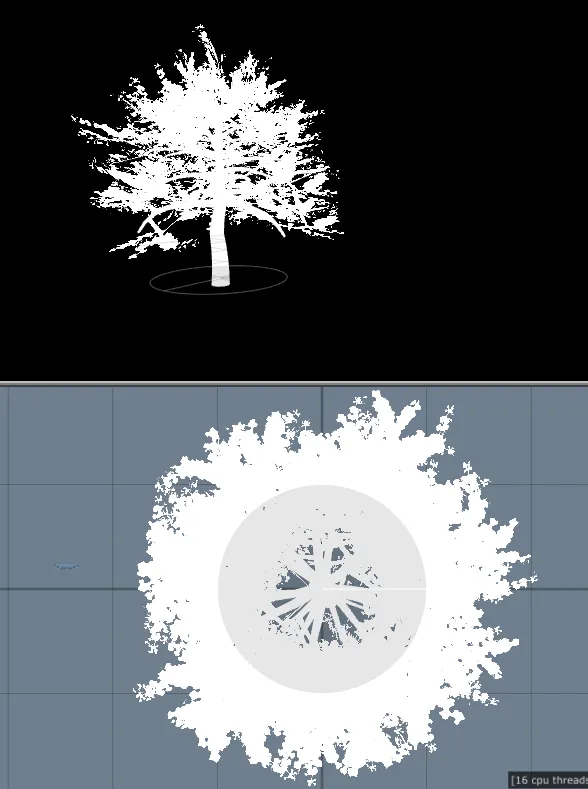
A large tree with every single detail constructed with geometry would be extremely taxing on a headset’s rendering engine- lowering the FPS well below what is comfortable for the player. Part of the design process is spent deciding which parts of the tree will be geometry and which parts will be cards (the flat pieces of geometry that can be used for things like leaves, small details, and finer branches). The player’s perspective plays a big part in deciding where we can shave off quite a bit of three-dimensional geometry. Since the player will only be able to look up at the tree, the level of detail can reduce quite dramatically as we move up the asset.

IMPLEMENTATION
Hand painted tree elements (leaves, fruits, small branches) are created and populated within SpeedTree. This hero Gingko went through several iterations to achieve a balance between the look we wanted and an efficient polycount for untethered VR.
Set wind conditions for a gentle sway, add some fireflies and periodically tumbling leaves, and you’ve got a perfect place to sit and relax or read the Korean books you just chose from the nearby bookshelf.

The Ginkgo tree is a lesson in how humans can and must play a significant role in preserving our planet. My hope is that XR applications can be used not to remove us further from the Earth, but reinforce the natural connection we already have.
Taste Korean is a continuing project. Follow us on LinkedIn for project and team updates!


Comments